Key Takeaways
No letter lands harder than a Notice to Appear, and no phone call lands harder than the one from a detention center. Deportation defense is the corner of this field where preparation meets fear, and where the difference between a practiced defense team and a hastily hired one shows up in whether children keep a parent at home. Our deportation lawyers in Dallas built this practice for exactly these cases: the father detained at a traffic stop, the mother with fifteen years here and a Notice to Appear with her name on it, the resident whose decades-old conviction resurfaced at the airport. This page explains how removal cases actually work at the Dallas court in 2026, what the new detention rules mean for North Texas families, and the defenses, led by cancellation of removal, that turn courtrooms into second chances.
Everything starts with the Notice to Appear, the charging document alleging why the government believes you are removable. Proceedings then run in two acts at the Dallas Immigration Court downtown. Master calendar hearings are short administrative appearances where pleadings are taken, defenses are identified, and deadlines are set; missing one is catastrophic, as explained below. The individual merits hearing is the trial itself: testimony under oath, documents admitted, witnesses examined, an ICE attorney arguing against you, and a judge ruling on the record. Filings move through the court’s electronic system on strict deadlines, and evidence submitted late is evidence the judge may never see.
Two practical habits protect every Dallas respondent from day one. First, verify your own case constantly: the automated line at 1-800-898-7180 and the portal at acis.eoir.justice.gov show your next hearing with your A-number, and we confirm every client’s docket ourselves rather than trusting memory or mail. Second, keep your address current with the court on Form EOIR-33 within five days of any move, because notices sent to an old address count as delivered, and the law removes people who never actually knew their court date.

Honest counsel requires describing the field as it is. Expedited removal, the fast-track process that bypasses the immigration judge entirely, has been expanded to its full statutory reach, applying anywhere in the country to people who cannot demonstrate two years of continuous presence, which is why we tell clients without status to carry proof of presence, leases, pay records, medical records, spanning more than two years. Arrests at and around immigration courts, including immediately after government motions to dismiss cases, have been documented across the country through 2025 and 2026, which changes how court appearances are planned and why nobody should attend a Dallas hearing without counsel and a contingency plan. And the detained docket moves at a different speed than the rest of the system: hearings come in days and weeks, while evidence-gathering from inside a facility is slow, an asymmetry that punishes every hour of delay in getting a removal defense lawyer in Dallas involved.
None of this is written to frighten anyone; it is written because families plan better with the truth. Our free Know Your Rights and Safety Planning resources exist for the same reason, and they are available above whether or not you ever hire us.
Most people detained in North Texas are held at the Prairieland Detention Center in Alvarado, about 40 miles southwest of Dallas, with others transferred to facilities farther out, such as the Bluebonnet Detention Center in Anson, or beyond Texas entirely. Locate anyone within hours using the ICE detainee locator at locator.ice.gov with a nine-digit A-number, padded with leading zeros, or an exact name and country of birth, and get the A-number to counsel immediately.
Then comes the question every family asks first, and the answer in Texas right now requires precision. People who were lawfully admitted, visa overstays and permanent residents among them, generally remain eligible for bond hearings under INA § 236(a), where a judge weighs flight risk and danger against family ties, work history, and community roots, unless a criminal ground triggers mandatory detention under INA § 236(c). But for people who entered without inspection, the Board of Immigration Appeals ruled in 2025, in Matter of Q. Li and Matter of Yajure-Hurtado, that immigration judges lack authority to grant bond at all, treating them as applicants for admission no matter how many years they have lived here. The Fifth Circuit, which governs Texas, upheld that position in February 2026; a panel of the same court briefly ordered custody hearings within 90 days in July; and on July 14, 2026 the full court vacated that ruling and set the case for rehearing in September 2026, leaving no-bond detention in force in Texas as of this writing, even as three other federal appeals courts have ruled the opposite way. What remains is fight: habeas corpus petitions in federal district court under 28 U.S.C. § 2241, custody redetermination requests where any admission can be shown, and relentless documentation for the hearing the moment the law provides one. Detained cases are emergencies at this firm, answered the same day, because in 2026 the calendar is the adversary.
A removal case is a container, and what goes inside it depends on your history. Cancellation of removal, detailed in the next sections, anchors the practice. Adjustment of status can be pursued in front of the judge for respondents with qualifying petitions, deciding the case with a Green Card instead of an order. Protection claims, asylum, withholding of removal, and Convention Against Torture relief, are raised and tried inside the same proceedings, with the full case-building treatment described on our asylum page. Survivors of abuse have VAWA-based routes, including a special cancellation provision, and victims of qualifying crimes may have U visa paths that support case management strategies. Old convictions sometimes carry waivers, such as INA § 212(h), and innocent misrepresentations at admission sometimes yield to the fraud waiver at INA § 237(a)(1)(H). Voluntary departure under INA § 240B, leaving at your own expense without a removal order, is occasionally the wise ending and often a trap, deserving of the honest analysis we give it in the FAQ below. What a family should never assume is that no defense exists: the menu is longer than people fear, and reading a full history against it is the first hour of work our deportation defense attorneys in Dallas perform on every new case.
Green card holders end up in removal proceedings more often than the public imagines, usually over convictions, sometimes decades old, that trigger the deportability grounds of INA § 237. For them, Congress built a second chance: cancellation of removal for permanent residents, which lets the judge erase the deportability entirely when the resident has held that status for five years, has resided continuously in the United States for seven years after a lawful admission, and has never been convicted of an aggravated felony as defined at INA § 101(a)(43).
Meeting the checklist only opens the door; the case is won on discretion. The judge weighs the conviction and its circumstances against the whole life: length of residence, family here, work and tax history, service, rehabilitation, hardship if deported. We build LPR cancellation cases like sentencing mitigation and biography at once, treatment records, employer letters, family testimony, community evidence, because a resident gets exactly one grant of this relief in a lifetime, and the file has to be worthy of it. The stop-time rule applies here too: the seven-year clock halts at service of a valid Notice to Appear or commission of certain offenses, so the arithmetic of dates decides eligibility before the equities are ever heard, and our Dallas cancellation of removal lawyers run those dates to the day.
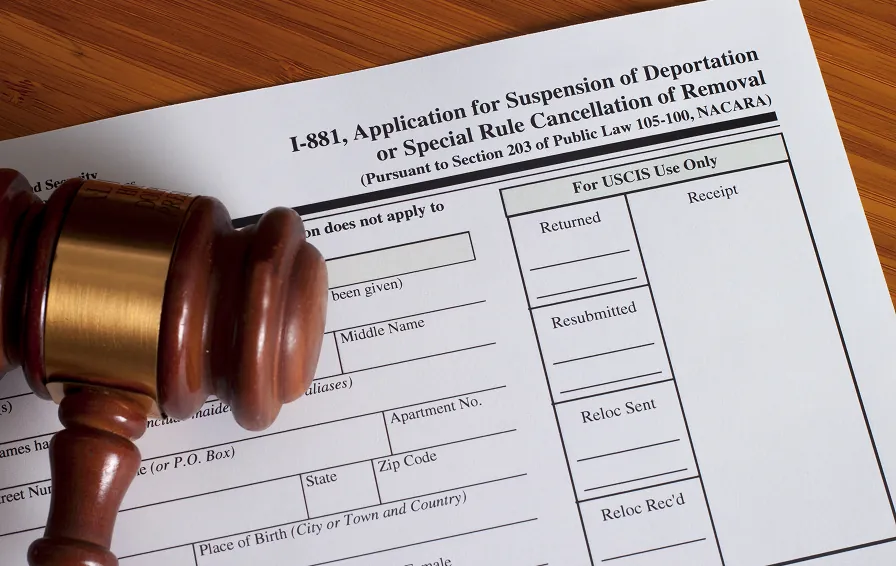
This is the defense most Dallas families are actually asking about when they call, and it deserves the fullest explanation on this page. Non-permanent residents in removal proceedings can win a Green Card from the judge by proving four things under INA § 240A(b): ten years of continuous physical presence in the United States before the stop-time date; good moral character throughout that period; no convictions under the disqualifying statutes; and, the summit of the case, that removal would cause exceptional and extremely unusual hardship to a spouse, parent, or child who is a U.S. citizen or permanent resident.
Every word of that last element is load-bearing. The hardship must land on the qualifying relative, never merely on the applicant; the qualifying relatives are only the spouse, parent, or child with status; and the standard, as the Board’s decisions in Matter of Monreal-Aguinaga and Matter of Recinas drew it, demands hardship substantially beyond the painful but ordinary consequences of any deportation. Family separation and economic loss alone rarely carry it. What carries it is specific, documented, cumulative proof: a citizen child’s medical condition and the treatment that does not exist in the country of removal, a special education program with records and evaluations, a disabled parent’s dependence, the compounding of factors that together make this family’s situation genuinely unusual. These cases are built over months, with school records, medical evaluations, country research, and testimony that has been prepared, which is why the years spent waiting for a merits hearing at the Dallas court are, in our hands, years spent building.
Two structural truths complete the honest picture. Congress caps non-LPR cancellation grants at 4,000 per year nationwide, so even winning cases are often “reserved,” with the judge’s grant finalized when a number becomes available, sometimes years later, while the family remains here with work authorization. And a special, gentler version exists for survivors: VAWA cancellation under INA § 240A(b)(2) asks three years of presence instead of ten and measures hardship to the applicant as well, one more reason survivors of abuse should be screened for every remedy at once.
Miss an immigration court hearing and INA § 240(b)(5) authorizes the judge to order removal in your absence, an order many people discover only years later at a license office or a checkpoint. The law allows rescission on two tracks: a motion filed within 180 days showing exceptional circumstances for the absence, serious illness, a family emergency, and similar events beyond your control, or a motion filed at any time showing you never received legally sufficient notice, a track the defective-notice case law has strengthened. Every in absentia case turns on records, hearing notices, addresses, postal history, so bring every scrap of paper to the consultation. And prevention remains free: file the EOIR-33 when you move, call the hotline before every hearing, and never assume a case was closed because time passed quietly.
A removal order narrows the road without always ending it. Appeals run to the Board of Immigration Appeals on a strict 30-day clock, work our appellate practice handles as its own discipline. Motions to reopen present new, previously unavailable evidence, including new relief eligibility, and motions to reconsider attack legal error. People facing imminent enforcement of an old order can request a stay of removal on Form I-246, filed with the ICE field office on North Stemmons Freeway in Dallas, with the documented equities, medical, family, pending filings, that give the request a chance. Honesty requires one hard warning here: for people who were removed and returned, INA § 241(a)(5) allows the government to reinstate the old order without a new hearing, leaving only fear-based protection screenings, so anyone with a prior removal should get counsel before any government contact, ideally years before. The pattern across all of it holds: the earlier the file reaches a deportation defense law firm in Dallas, the more doors remain open.
Thousands of North Texans live under orders of supervision, reporting to ICE on schedules that used to feel routine and no longer do. In the current climate, check-ins at the Dallas field office deserve preparation: attend with counsel or with counsel on call, carry a folder proving equities and any pending applications, leave a family plan at home, powers of attorney for children, financial access, our Safety Planning Guide completed, and never skip a date, because absconding converts a manageable file into a priority one. Dallas Immigration Attorneys prepares clients for check-ins as a formal service, because the era of treating them casually is over, and because a person who walks in documented and represented walks in stronger.
Removal defense is where this firm’s habits matter most. Detained calls are answered and acted on the same day, with the locator search, the A-number, and the custody analysis done before the family sleeps. Merits hearings are built months ahead, on evidence, witness preparation, and country research, never on a morning’s improvisation. Strategy is written down, priced honestly, and reviewed by more than one attorney, because a courtroom case deserves more than one mind. And the truth gets told at the start, including when the honest advice is that the strongest path is protection, or a waiver, or, rarely, a negotiated departure that preserves a future return. Deportation defense lawyers in Dallas are plentiful; defense built like the family’s future depends on it, because it does, is the standard here.
If someone you love has been detained, if a Notice to Appear has arrived, if an old order surfaced, or if a check-in is coming and your stomach already knows it matters, the next step is one confidential conversation, in English or Spanish, where we read the record, run the dates, and hand you the plan.
Call Or Text (945) 202-5299 To Reach A Deportation Defense Attorney In Dallas. Detained Cases Are Answered Same Day.